How ChatGPT Works: A Simple Explanation for Beginners (2026 Guide)
Artificial intelligence (AI) is changing the way people learn, work , work and communicate. One of the most , most popular artificial intelligence tools today is ChatGPT, that helps millions of users write content, answer QUESTIONS, generate ideas, and even write computer code.
In this beginner-friendly guide, we explain everything in simple language without , without any technical background.
What is ChatGPT?
ChatGPT is an AI-powered chatbot developed by OpenAI. It understands human language and generates natural, human-like responses.
Instead of searching for web pages like a search engine, ChatGPT predicts the most suitable response based on your question and its training.
Example
You ask:
“Write a professional email.”
ChatGPT replies:
It instantly creates a complete email based on your request.
How Does ChatGPT Work?
Think of ChatGPT as a very advanced text prediction system.
It doesn’t “think” like humans. Instead, it predicts which word should come next based on patterns learned from enormous amounts of text.
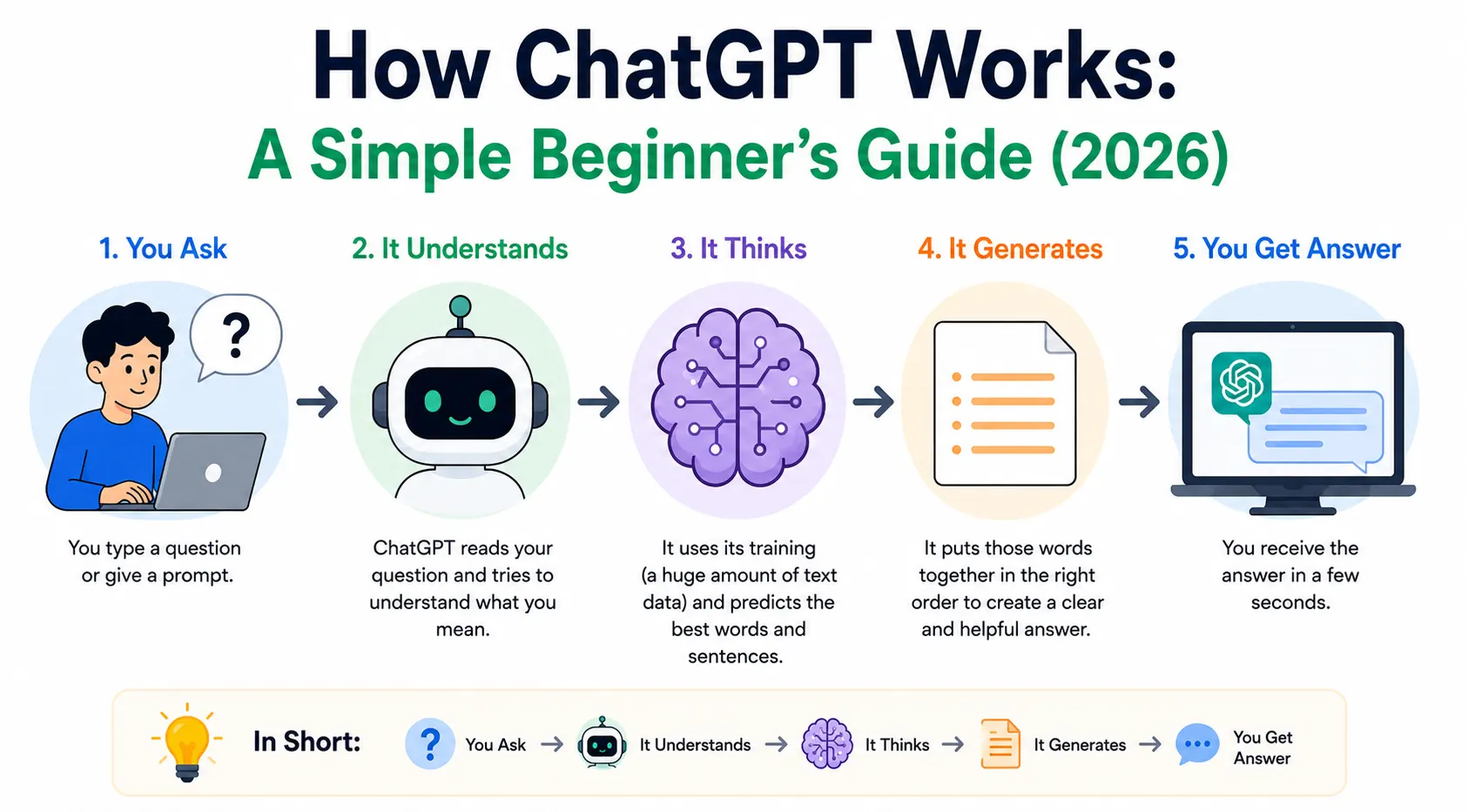
The process looks like this:
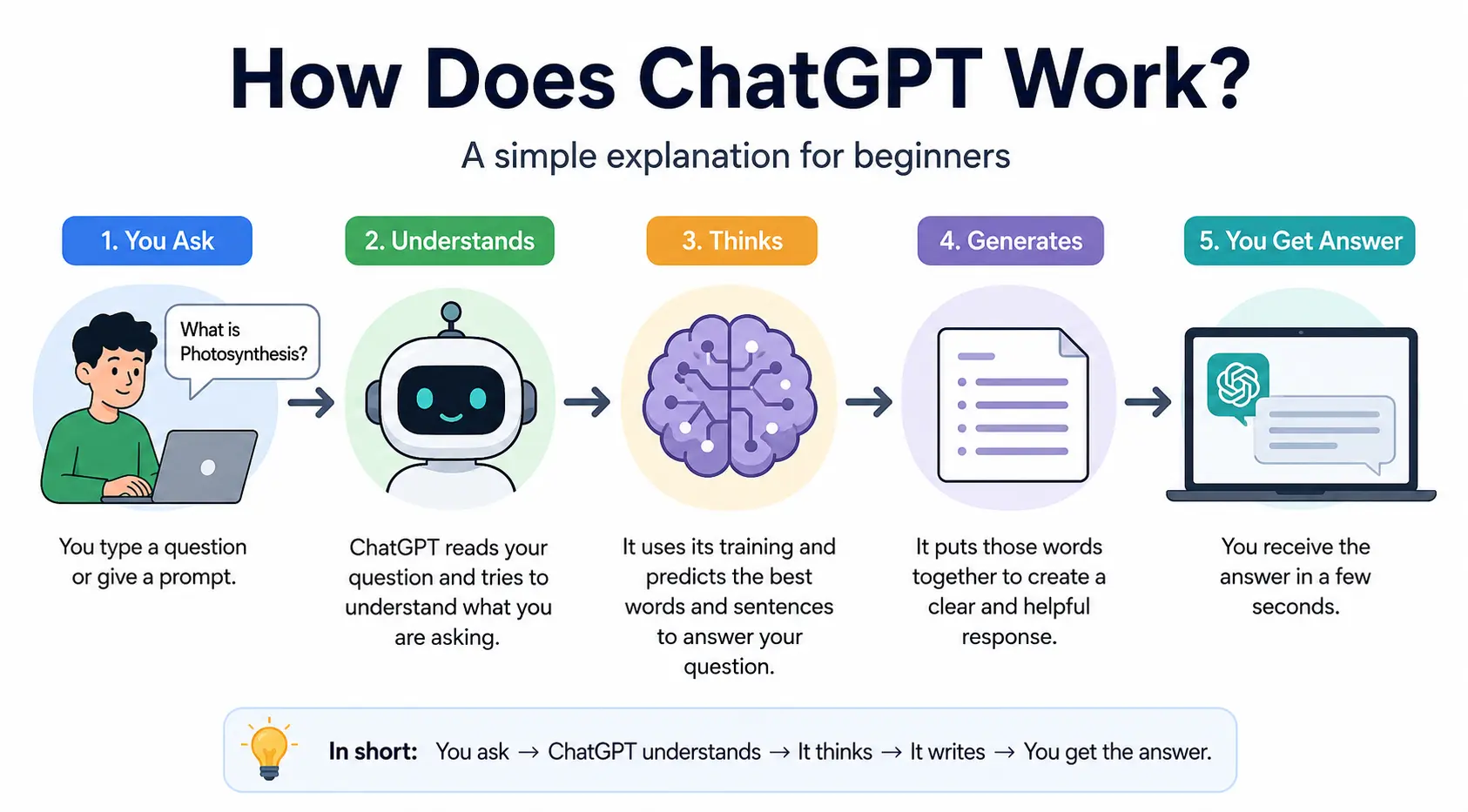
Step 1: You Type a Prompt |
Step 2: ChatGPT Understands Your Request |
Step 3: AI Predicts the Best Response |
Step 4: The Response is Generated |
|
Everything starts with your question or instruction. Examples:
This is called a prompt. |
The AI analyzes:
It determines what you’re asking before generating a response. |
Instead of searching a database for an exact answer, ChatGPT predicts the most likely sequence of words that should come next. This prediction happens billions of times in just a few seconds. |
Finally, ChatGPT sends back a complete response that sounds natural and conversational. The whole process usually takes less than a second. |
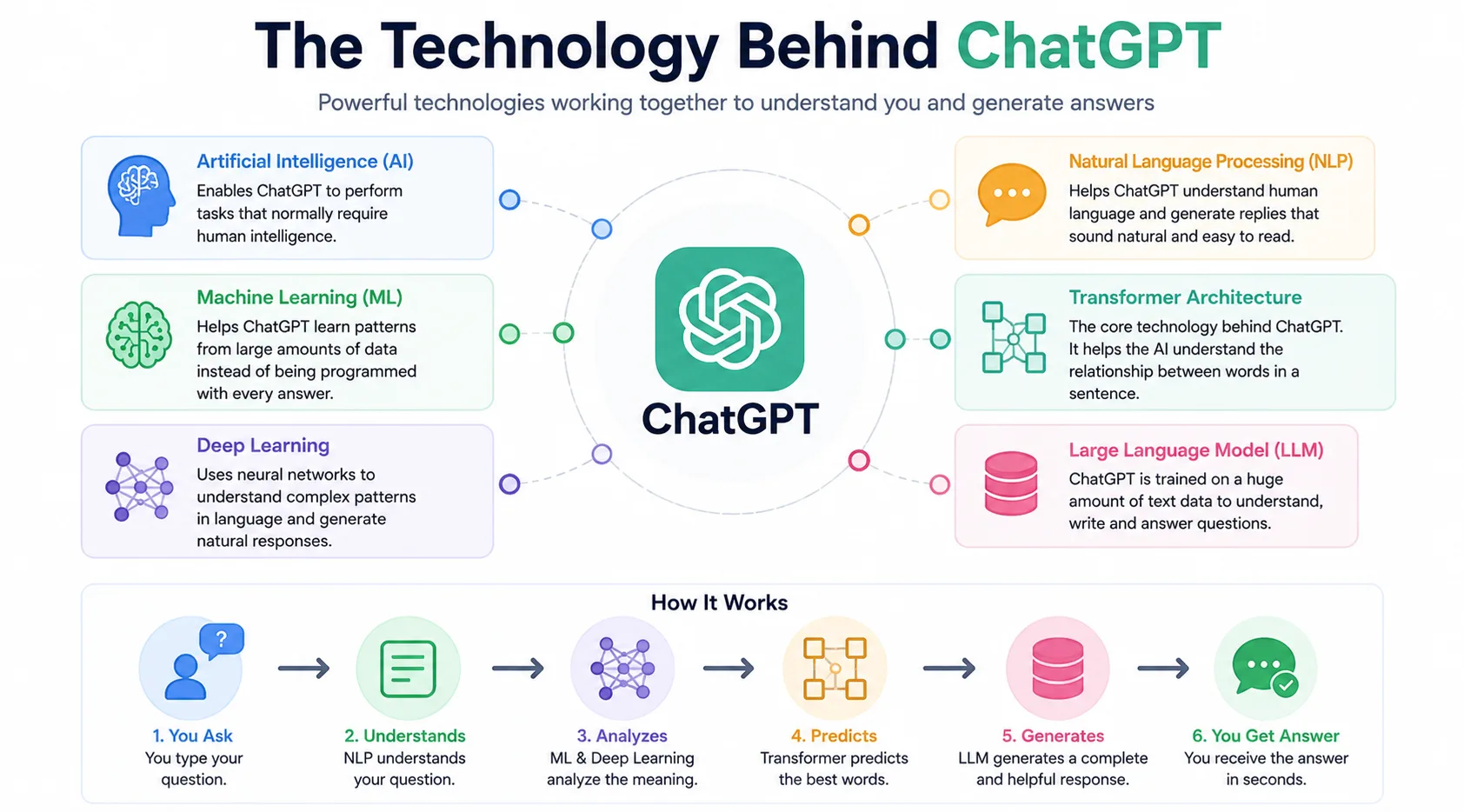
The Technology Behind ChatGPT
ChatGPT is based on a type of AI model called a Transformer.
Transformers are designed to understand relationships between words in a sentence, making conversations feel more natural.
Key technologies include:
- Artificial Intelligence (AI)
- Machine Learning (ML)
- Deep Learning
- Natural Language Processing (NLP)
- Transformer Architecture
- Large Language Models (LLMs)
Together, these technologies help ChatGPT understand language and generate useful responses.
What is an LLM?
LLM stands for Large Language Model.
It is an AI system trained on massive amounts of text, including:
- Books
- Articles
- Websites
- Educational materials
- Public documents
- Programming code
The model learns language patterns rather than memorizing every document.
How Was ChatGPT Trained?
The training process involves three major stages:
|
1. Data Collection |
2. Pattern Learning |
3. Fine-Tuning |
|
The AI learns from large collections of publicly available and licensed text. |
Instead of memorizing facts, it learns:
|
Human trainers improve the model by helping it produce:
|
Does ChatGPT Search the Internet?
The answer is not always.
It depends on which version of ChatGPT you are using.
Standard ChatGPT
The standard version does not search the internet while answering. It uses the knowledge it learned during training to create a response.
This makes it fast and useful for explaining topics, writing content, solving problems, and answering general questions. However, it may not know the latest news or recent events.
Web-enabled ChatGPT
The web-enabled version can search the internet when needed. This helps it find the latest information, such as today’s news, recent sports scores, stock prices, new product launches, or updated government notifications.
What’s the Difference?
|
Standard ChatGPT |
Web-enabled ChatGPT |
|
Uses its trained knowledge |
Can search the internet when needed |
|
Best for general questions and writing |
Best for recent news and live information |
|
May not know the latest updates |
Can provide current and updated details |
|
Works without searching the web |
Searches trusted online sources when required |
How ChatGPT Generates Answers ?
Many people think ChatGPT copies answers from websites, but that’s not true. It creates a new response every time based on your question.
|
Step |
What ChatGPT Does |
Simple Explanation |
|
1. Reads Your Question |
ChatGPT reads your prompt carefully. |
It first understands what you are asking. |
|
2. Understands the Meaning |
It analyzes your words and the context. |
It tries to understand the purpose of your question. |
|
3. Uses Its Knowledge |
It uses what it learned during training. |
It doesn’t search a website unless web search is enabled. |
|
4. Predicts the Next Words |
It predicts one word after another. |
This is how it builds a complete answer. |
|
5. Creates a New Response |
It generates fresh content. |
It doesn’t simply copy and paste text. |
|
6. Sends the Answer |
The final response appears on your screen. |
This usually takes only a few seconds. |
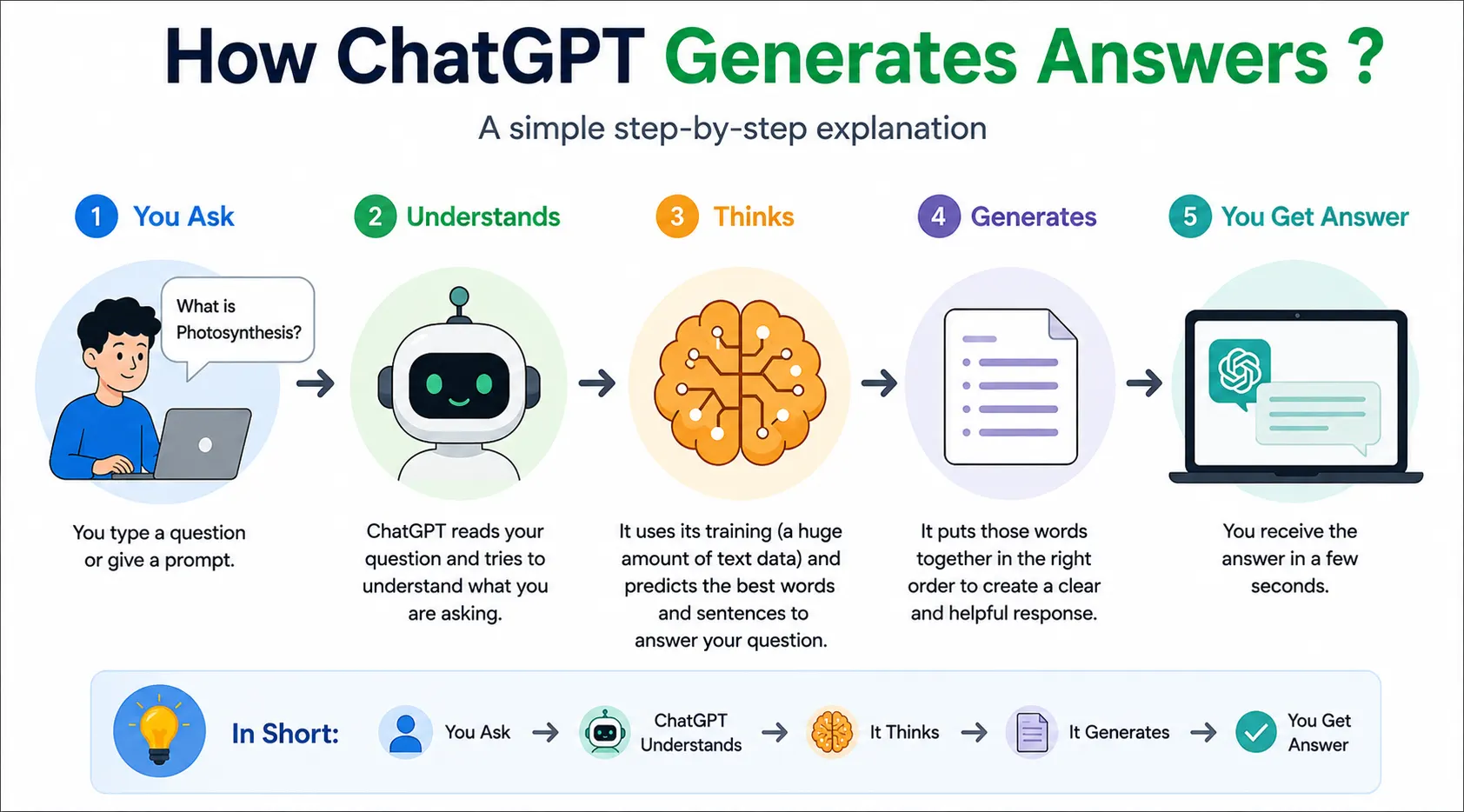
Example
Suppose you ask:
“Write a 100-word paragraph about trees for Class 8 students.”
Here’s what happens:
- ChatGPT reads your question.
- It understands that you want a short paragraph.
- It knows the language should be simple because it’s for Class 8 students.
- It predicts the best words and sentences.
- It creates a new paragraph and shows it to you.
Key Points
- It understands your question before answering.
- It uses knowledge learned during training.
- It predicts words one by one to create sentences.
- It generates a fresh response instead of copying text.
- Clear prompts usually give better answers.
- You can ask follow-up questions to continue the conversation.
Limitations of ChatGPT!
ChatGPT is a powerful AI tool, but it is not perfect. Like any technology, it has some limitations that users should know.
|
1. Hallucinations |
2. Outdated Knowledge (Depending on the Version) |
3. Can Make Mistakes |
4. Doesn’t “Understand” Like Humans |
|
Sometimes ChatGPT can give information that sounds correct but is actually wrong or completely made up. This is called a hallucination. That’s why it’s always a good idea to check important facts from trusted sources. |
Some versions of ChatGPT may not have the latest information. They might not know about recent news, new laws, product launches, or events unless they have access to the internet. |
ChatGPT can sometimes misunderstand your question or give an incorrect answer. It may also make spelling, calculation, or factual mistakes. If you’re using it for school, work, or important decisions, always double-check the information. |
ChatGPT can understand patterns in language, but it doesn’t think or feel like a human. It has no emotions, opinions, or personal experiences. It simply predicts the most suitable words based on your prompt and what it learned during training. |
Frequently Asked Questions (FAQs) |
| 1. Is ChatGPT free?
Yes, ChatGPT has a free version that anyone can use. There are also paid plans that offer extra features, faster responses, and higher usage limits. |
| 2. Is ChatGPT accurate?
ChatGPT is often accurate, but it is not perfect. Sometimes it can give incorrect or outdated information, so it’s important to check important facts from trusted sources. |
| 3. Does ChatGPT learn from me?
ChatGPT can use the current conversation to give better replies, but it doesn’t automatically remember everything you say forever. Some versions include an optional memory feature that remembers information only if you choose to use it. |
| 4. Who created ChatGPT?
ChatGPT was created by OpenAI, an Artificial Intelligence research and technology company based in the United States. |
| 5. Is ChatGPT safe?
Yes, ChatGPT is generally safe to use. However, you should avoid sharing personal information such as passwords, bank details, or other sensitive data. |
| 6. Can ChatGPT replace Google?
No. ChatGPT and Google serve different purposes. ChatGPT is great for explaining topics, writing content, and answering questions, while Google is better for finding websites, official documents, and the latest news. |
| 7. Is ChatGPT connected to the internet?
Not always. Some versions answer using their trained knowledge, while web-enabled versions can search the internet when needed to provide up-to-date information. |
| 8. Can ChatGPT write code?
Yes. ChatGPT can write, explain, and debug code in many programming languages such as Python, Java, C++, JavaScript, and HTML. |
| 9. What does GPT stand for?
GPT stands for Generative Pre-trained Transformer. It is the AI technology that powers ChatGPT. |