E U everyday UPDATES

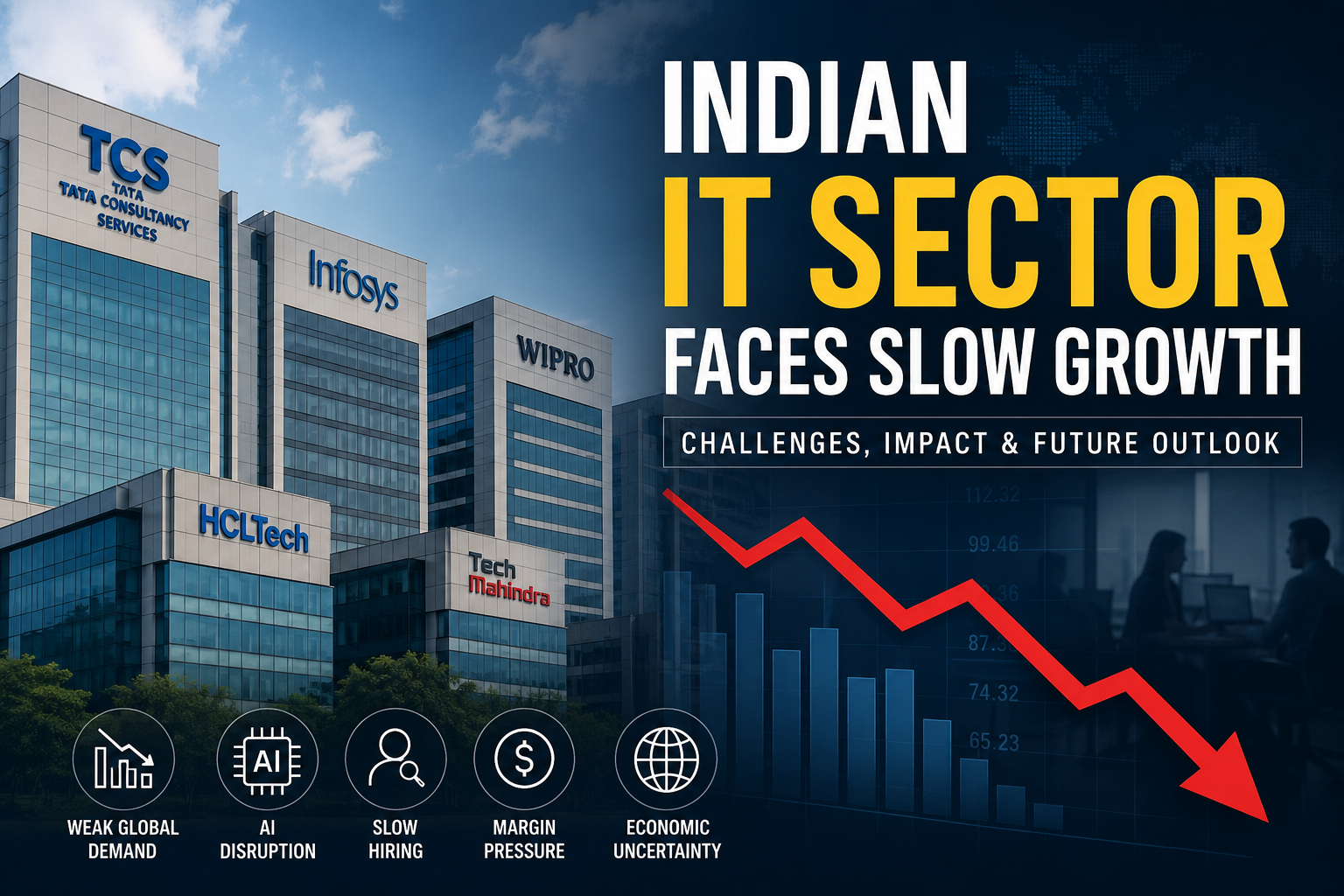
Indian IT Sector Faces Slow Growth (July 2026)

Indian IT Sector Faces Slow Growth

Indian IT Sector Faces Slow Growth in 2026: What's Driving the Slowdown?

India's IT sector, long the engine of the country's services exports, is passing through one of its most difficult phases in two decades. Weak global demand, cautious client spending and the rapid rise of artificial intelligence have combined to slow growth across the Indian IT industry in 2026.The June-quarter (Q1 FY27) results from TCS, HCLTech, Wipro and Tech Mahindra confirm the trend. Revenue is still growing — but slowly, and mostly in low single digits in constant currency. Investors, employees and freshers are all asking the same question: is this a temporary dip or a structural reset?

Indian IT Sector Growth in 2026: Where the Industry Stands

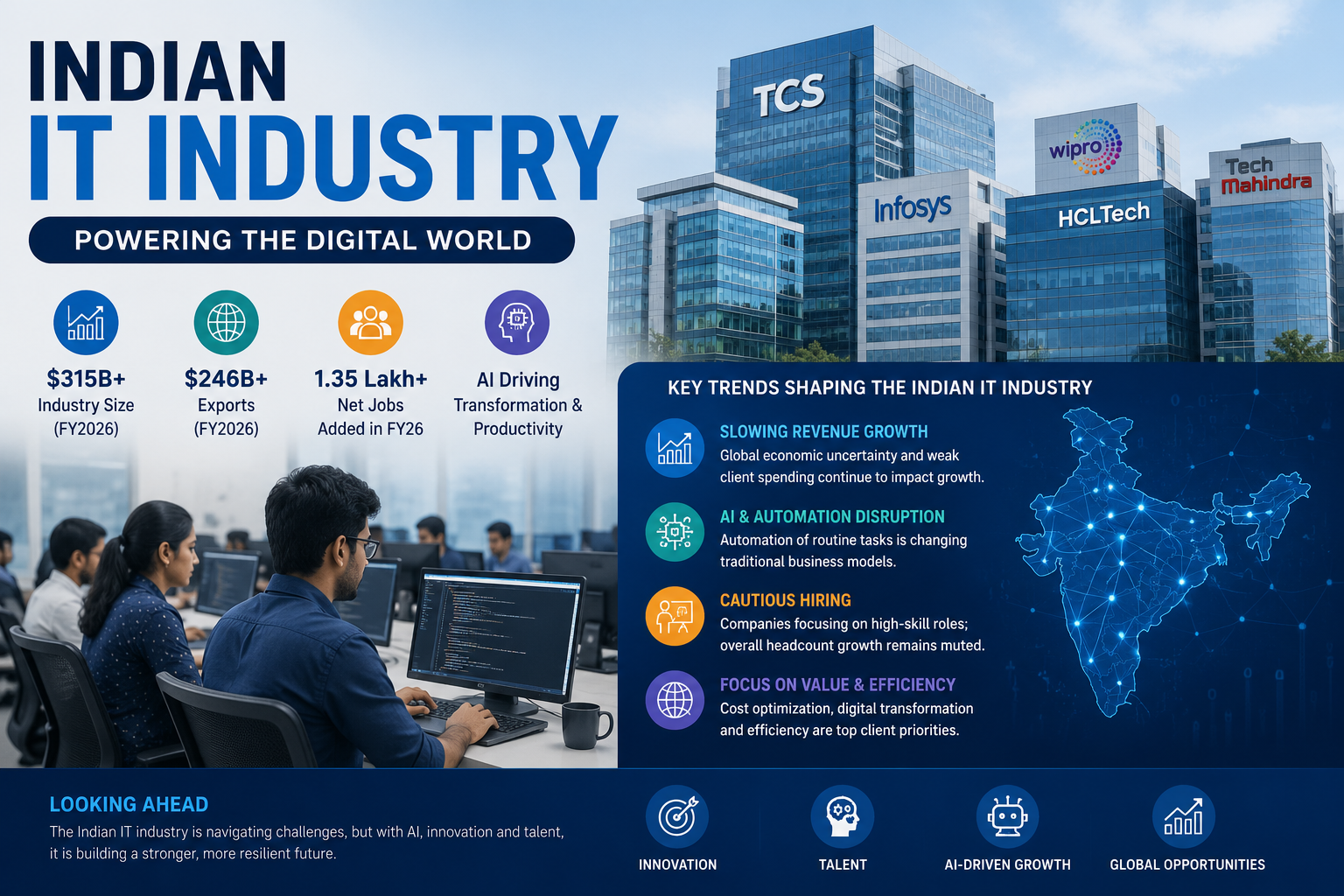
According to NASSCOM's Annual Strategic Review 2026, Indian tech industry revenue is estimated at $315 billion in FY26, up 6.1% from a revised $297 billion in FY25. Exports are estimated at around $246 billion.That headline number hides the stress. Growth of ~6% is far below the double-digit expansion the IT sector delivered for most of its history, and headcount grew just 2.3% — only about 1.35 lakh net jobs added — showing that revenue and hiring have decoupled.The stock market has been harsher. In early February 2026, the Nifty IT index fell roughly 19% in just eight trading sessions, wiping out close to $50 billion in market value — its sharpest fall since the 2008 crisis. By early July 2026, the combined market capitalisation of the top five IT companies had dropped more than 46% from its August 2024 peak, and TCS lost its long-held position as India's most valuable listed company to Reliance Industries.

Key Reasons Behind the Slowdown

Weak global IT demand:

The US accounts for roughly 54–55% of India's IT exports. Cautious discretionary spending by American and European clients is directly shrinking deal pipelines. Accenture's June 2026 decision to cut its annual growth guidance to 3–4% (from 3–5%) triggered a global sell-off, dragging the Nifty IT down about 6% to a three-year low.

AI-led pricing pressure:

Clients now expect AI-driven productivity gains to be passed back as lower billing, squeezing the traditional time-and-material model.

Automation of routine work:

Agentic AI tools are automating coding, testing and maintenance — the bread-and-butter of the Indian IT slowdown story, since these services built the sector's headcount-led growth model.

Geopolitical and policy headwinds:

The West Asia conflict, tariff uncertainty and the steep $100,000 H-1B visa fee announced by the US in late 2025 have delayed client decision-making.

Foreign investor exit:

FIIs pulled an estimated ₹74,000+ crore out of Indian IT stocks through 2025, pushing holdings to multi-year lows.

Margin pressure:

Annual wage hikes plus heavy AI investments compressed margins — TCS at 24% and Wipro at 15.6% (down 170 bps sequentially) in Q1 FY27.

Company Current Situation (Q1 FY27) Future Outlook
TCS Revenue ₹72,275 crore (+13.9% YoY in rupee terms, +0.4% CC QoQ); Net Profit ₹13,349 crore (+4.6%); Order Book $9.5 billion; AI business at a $2.6 billion annual run rate. Selective hiring resumed (+9,279 employees in Q1); focus on margin recovery and AI deal conversion.
Infosys Q1 FY27 results awaited (late July 2026); FY27 guidance stands at 1.5–3.5% constant currency growth. Analysts expect the upper end of guidance to be trimmed; Optimum Healthcare acquisition may add around 1.2% to revenue.
Wipro Net Profit ₹3,360 crore (nearly flat YoY); IT Services Revenue +0.9% CC YoY; Operating Margin 15.6%. Pipeline remains focused on cost-optimization deals with cautious near-term guidance.
HCLTech Net Profit up 20.3% YoY; Headcount declined by 3,292, the steepest fall in five quarters. FY27 constant currency growth guidance of around 1–4%; investing heavily in AI-driven productivity.
Tech Mahindra Revenue ₹15,712 crore (+4.2% QoQ); EBIT Margin improved by 60 bps to 14.4%. Relative outperformer with strong deal wins and continued margin expansion.

AI Impact on Indian IT: A Structural Shift, Not Just a Cycle, Indian IT Sector Faces Slow Growth

What makes 2026 different from earlier downturns is the explanation behind it. Previous slowdowns were blamed on over-hiring or macro cycles. This time, the AI impact on Indian IT is forcing a repricing of the entire business model.For decades the formula was simple: more engineers meant more revenue. Agentic AI breaks that link by automating routine development and maintenance work.Yet AI is also the biggest new opportunity. NASSCOM estimates AI-related revenue at $10–12 billion in FY26, TCS already reports a $2.6 billion AI annualised run rate, and over 20 lakh professionals have been upskilled in AI. Digital transformation demand has not disappeared — it is changing shape, moving toward outcome-based and AI-led deals.

Indian IT Industry

IT Hiring in India: Pressure on Freshers and Employees

IT hiring in India has turned selective rather than stopping outright. TCS reduced headcount by an estimated 23,000–25,000 during FY26 before adding 9,279 employees in Q1 FY27, including around 14,000 campus graduates. Wipro added just 888 people and onboarded no fresh engineering graduates in the quarter, while HCLTech’s headcount fell by 3,292 even as it added about 1,056 freshers.

Attrition is at multi-year lows of roughly 12.7–13.8%, which also means fewer replacement vacancies. Demand has shifted sharply toward GenAI and AI-engineering skills, where recruiters report a wide gap between openings and trained candidates. Global Capability Centres (GCCs) have emerged as a strong parallel hiring track.

What This Means for IT Professionals

  • Upskill first: GenAI, agentic AI, cloud, data engineering and cybersecurity are where hiring is concentrated.

  • Freshers: Companies now prefer AI-native profiles. Certifications, live projects and internships matter more than mass campus drives.

  • Mid-career employees: Move toward AI-adjacent roles (AI operations, model testing, MLOps) and build domain depth in BFSI, healthcare or retail.

  • Look beyond the top five: Mid-tier firms such as Persistent, Coforge and Mphasis, plus GCCs, are growing faster than tier-1 companies.

  • Job security: Stable performers with current skills face limited risk; roles built purely on routine coding or manual testing carry the highest exposure.

Expert Analysis

Brokerages remain cautious in the near term. Motilal Oswal expects soft demand commentary to extend into Q2 FY27 and has cut target valuation multiples by 15–20% across its IT coverage, noting tier-1 stocks now trade 30–40% below their long-term average valuations. Gartner analysts say growth for firms like Wipro will depend on converting strong deal momentum into actual revenue and scaling AI-led transformation programmes.

NASSCOM’s leadership offers the balancing view: AI has moved from experimentation to function-specific deployment, and the industry remains a net job creator. The emerging consensus is that the Indian IT sector is not collapsing — it is being separated into AI-ready winners and structural laggards.

Indian IT Market Outlook: Global IT Demand and the Road Ahead

In the short term, the Indian IT market is likely to stay muted. Key triggers to watch include Infosys’s FY27 guidance revision, any recovery in discretionary global IT demand in the second half, and quarterly AI-revenue disclosures.

Over the medium term, the structural drivers remain intact: enterprises worldwide still need digital transformation, India retains its cost and talent advantage, and GCCs plus engineering R&D continue to expand. A return to 2021-style hyper-growth looks unlikely, but analysts broadly expect the IT sector to stabilise as AI deals scale and pricing models mature through FY27–FY28.

FAQ: People Also Ask

Q1. Why is the Indian IT sector facing slow growth in 2026?
A combination of weak US and European demand, AI-driven pricing pressure, delayed deal decisions due to geopolitical uncertainty, and automation of routine services has slowed revenue growth to low single digits for most large IT companies.

Q2. Will AI replace jobs in the Indian IT industry?
AI is automating routine coding, testing and maintenance roles, but it is also creating demand for AI engineering, data and cloud skills. NASSCOM data shows the industry still added about 1.35 lakh net jobs in FY26, though growth is much slower than before.

Q3. Which Indian IT company performed best in Q1 FY27?
Tech Mahindra stood out on margin improvement and sequential growth, while HCLTech posted the strongest profit growth (up 20.3%). TCS beat street estimates on revenue, whereas Wipro missed expectations with nearly flat profit.

Q4. Is 2026 a good year for freshers to join the IT sector?
Hiring is selective, not closed. TCS onboarded around 14,000 campus graduates in Q1 FY27 alone. Freshers with GenAI, cloud and data skills have a clear advantage, and GCCs offer an additional hiring route.

Q5. When will the Indian IT sector recover?
Most analysts expect gradual stabilisation through FY27–FY28 as AI deals scale and global IT demand improves. A quick V-shaped recovery is unlikely; the sector is undergoing a structural transition rather than a routine cyclical dip.

Read More Trending Articles

Related articles

GOLD RATE TODAY
22K Gold₹1,32,200 / 10g
24K Gold₹1,44,220 / 10g
City-Wise: Gold Rates
City22K24K
Delhi₹1,31,650₹1,43,610
Mumbai₹1,31,250₹1,43,190
Indore₹1,31,850₹1,43,510
Varanasi₹1,32,500₹1,39,130
Updated 7 days ago
PETROL & DIESEL RATE TODAY
Petrol · Delhi ₹94.77 / litre
Diesel · Delhi ₹87.67 / litre
City-Wise: Petrol & Diesel
CityPetrolDiesel
Delhi ₹94.77
₹87.67
Mumbai ₹103.50
₹90.03
Indore ₹106.48
▲ ₹0.12
₹91.88
▲ ₹0.10
Bhopal ₹106.44
▼ ₹0.08
₹91.81
▼ ₹0.05
Updated 1 second ago · revised daily at 6 AM
BITCOIN RATE TODAY
Bitcoin BTC ₹60,59,901 $63,204.00 ▼ -3.22% 24h
Updated 18 minutes ago · live via CoinGecko